
CCS in 1-2-3
CCS (Carbon Capture and Storage) is a technology for capturing, transporting and permanently storing CO2. CO2 is captured from industrial facilities or other emission sources and transported to a suitable geological storage site underground or beneath the seabed. CCS is an important climate mitigation measure, particularly for industries where emissions are difficult to avoid.
CCS can be used in bio-based industries (bio-CCS or BECCS) as a technology to achieve negative CO2 emissions by removing CO2 from the atmosphere. CCS can also be used in hydrogen production from natural gas, where CO2 is captured and stored. The result is low-emission hydrogen (blue hydrogen), which can help reduce emissions from applications such as heating buildings and industrial facilities, heavy-duty transport and the maritime sector.
“Carbon dioxide has been transported for more than 40 years, particularly in the United States.”
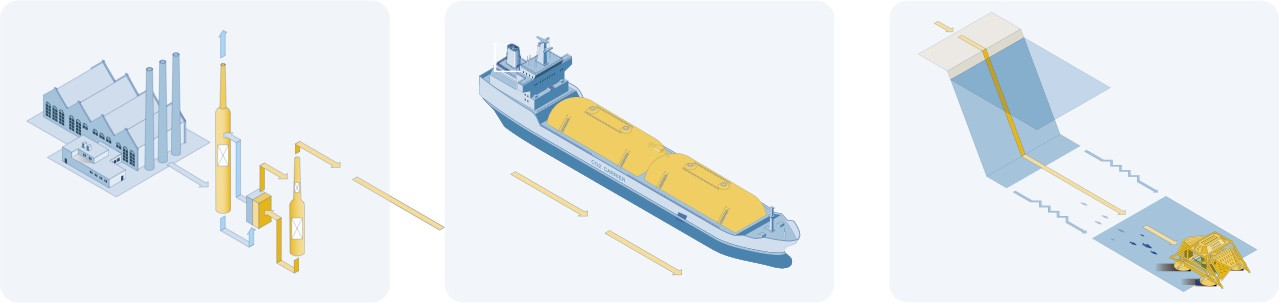
1. Capture
The first stage of the CCS process involves capturing CO2 from flue gases generated by the combustion of fossil fuels or biomass, or from industrial processes such as steel, cement and chemical production, as well as refining. Several CO2 capture technologies are available at different levels of maturity. In some cases, CO2 capture is an integral part of the production process. Costs vary between emission sources and depend on factors such as the CO2 concentration in the flue gas, access to affordable energy and heat, and the potential for integrating capture technology into existing production processes.
2. Transport
After capture, CO2 is transported by pipeline or ship to a suitable storage site. The transport technologies are largely based on established solutions for transporting CO2 and natural gas. CO2 has been transported for more than 40 years, particularly in the United States, where the technology has been used, among other applications, for enhanced oil recovery (EOR).
3. Storage
CO2 can be isolated from the atmosphere using various methods. Geological storage is currently considered one of the most cost-effective and safe solutions for permanently storing large volumes of CO2. This method involves storing CO2 deep underground or beneath the seabed in suitable geological formations. After being transported to the storage site, CO2 is injected into a geological reservoir, often consisting of porous rock formations containing saline water. The CO2 enters small, interconnected pores in the rock and is held in place by overlying impermeable rock layers that prevent leakage. The technology builds on extensive experience with underground CO2 injection, particularly from the oil and gas industry.